
During the Paschal Triduum, the Church has a special prayer called Tinieblas, from the Latin Tenebrae, which means “darkness.” It is usually prayed early in the morning and invites us to slow down and reflect on the suffering and death of Jesus.
Tinieblas comes from the Church’s old morning prayers—Matins and Lauds—for Holy Thursday, Good Friday, and Holy Saturday.
In the past, these were prayed before sunrise, when everything was still quiet. This timing helped people feel the silence and sadness of those days. Over time, it became a meaningful way for the faithful to enter into the story of Jesus’ Passion, not just by listening, but by experiencing it.
Bringing Tinieblas closer to the Cebuano faithful
In Cebu, this tradition became even more meaningful through the work of Msgr. Rodolfo “Rudy” Villanueva. He translated and arranged the Tinieblas in Cebuano, making it easier for people to understand and pray.
Because of this, many communities don’t just recite Tinieblas—they sing it in Cebuano. This helps people connect more deeply with the prayer. It turns an old Church tradition into something that feels close, familiar, and alive.
What happens during the Tinieblas?
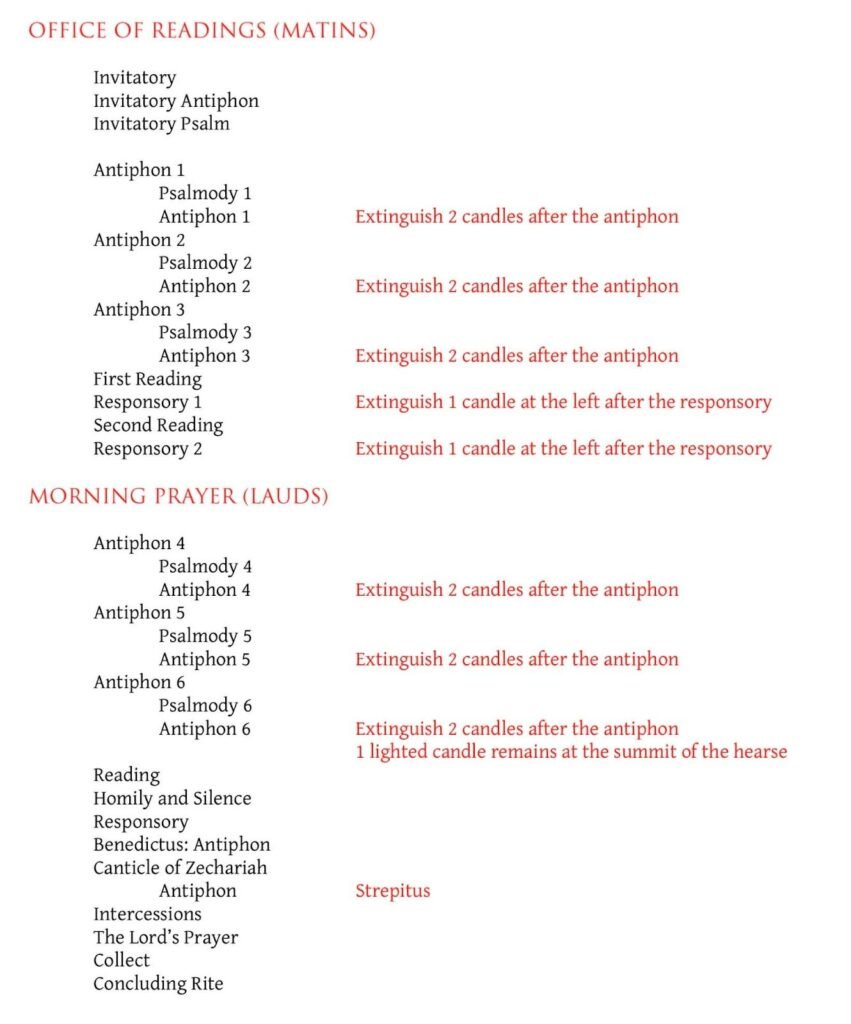
As the liturgy unfolds, a key action takes place: candles are extinguished one by one after each psalm or reading, gradually darkening the church. Near the end, only one candle remains, which is then temporarily hidden from view, followed by a sudden loud noise called the strepitus. The prayer ends with the final blessing. The faithful leave quietly—carrying the solemn mood of Christ’s suffering and death.
Symbolisms in the Tinieblas
Gradual Extinguishing of Candles
As the prayer continues, candles are extinguished one by one, gradually dimming the church. This represents how Jesus was abandoned by His disciples and how the light of hope seemed to fade as He approached death. It invites the faithful to reflect on moments of loneliness, suffering, and loss.
The 15 Candles (Tenebrae Hearse)
The candles are traditionally placed on a triangular stand called the Tenebrae hearse, with each candle linked to specific psalms and readings. As they are extinguished, only one candle remains—the symbol of Christ as the Light of the World. This reminds us that even when darkness grows, Christ’s presence remains.
Darkness in the Church
As more candles are put out, the church slowly falls into darkness. This reflects the darkness that covered the earth during Christ’s crucifixion and symbolizes the spiritual blindness of humanity. It creates a powerful atmosphere of mourning and reflection.
The “Strepitus” (Loud Noise)
At the end of the prayer, a sudden loud sound breaks the silence. This represents the earthquake at the moment of Jesus’ death and the closing of His tomb. It serves as a dramatic reminder of the reality and finality of His sacrifice.
The Hidden Candle
The final candle is not blown out but hidden, showing that Christ’s light is not truly extinguished. Though He dies, His presence remains and points toward the Resurrection. It is a quiet but powerful sign of hope in the midst of darkness.
Sequence of the Tinieblas
The following is the sequence of the Tinieblas as prescribed by the Cebu Commission on Worship:
Today, Tinieblas reminds us of something important: faith is not only about joy and celebration. Sometimes, it’s about staying in the silence, facing the darkness, and trusting that light will come again.
Because even when everything seems dark, the light of Christ is never really gone.